
Culture Breakdowns Rarely Begin With Dramatic Events
How the Civility Risk Chain™ shows the path from everyday strain to organizational risk
Organizations invest heavily in culture. They publish value statements, run engagement surveys, and develop leadership programs intended to strengthen collaboration and trust.
Yet many cultural breakdowns do not begin with dramatic events. They begin with a gradual negative drift in everyday behavioral norms. When those norms begin to shift — even slightly — the effects compound across meetings, decisions, and relationships long before any formal indicator suggests something is wrong.
According to SHRM's Civility Index, nearly three-quarters of U.S. workers report experiencing or witnessing incivility in the workplace, and the resulting productivity loss is estimated at roughly $2 billion per day across U.S. organizations.
How the Civility Risk Chain™ shows the path from everyday strain to organizational risk
By Dr. Michelle C.L. Powell · Founder, The Civility Doctor
Originally published on LinkedIn, March 2026 · Adapted for The Civility Doctor Insights, May 2026
Organizations invest heavily in culture. They publish value statements, run engagement surveys, and develop leadership programs intended to strengthen collaboration and trust.
Yet many cultural breakdowns do not begin with dramatic events. They begin with a gradual negative drift in everyday behavioral norms. When those norms begin to shift — even slightly — the effects compound across meetings, decisions, and relationships long before any formal indicator suggests something is wrong.
According to SHRM's Civility Index, nearly three-quarters of U.S. workers report experiencing or witnessing incivility in the workplace, and the resulting productivity loss is estimated at roughly $2 billion per day across U.S. organizations.
Workplace incivility is low-intensity deviant behavior that violates the norms of mutual respect. Individual incidents are often ambiguous in intent, but a pattern of these violations signals diminishing respect between colleagues — and, unchecked, it can worsen and spread through the organization.
Incivility may eventually escalate into open conflict, but it more often appears first as tension, mistrust, or quiet disengagement within teams. Conflict itself is not the problem — healthy disagreement is essential for strong decision-making. The risk emerges when everyday standards for interaction begin to drift in ways that quietly undermine trust, collaboration, and productivity.
Behavioral Drift and the Normalization of Small Deviations
In high-pressure environments, behavioral norms rarely collapse all at once. Instead, they shift gradually.
Organizational strain — competing priorities, sustained excessive workloads, leadership transitions, or rapid change — often creates small behavioral adjustments that initially appear reasonable or even necessary.
Thoughtful dialogue is replaced with shorter, transactional conversations.
Responses become delayed.
Follow-through weakens.
Difficult conversations are postponed or avoided.
Workarounds replace direct discussion.
Over time, these adjustments accumulate. What once felt temporary begins to feel normal.
Researchers studying safety in high-risk industries have long observed a phenomenon known as behavioral drift, or what safety scientist Sidney Dekker describes as the "drift into failure." Dekker, known for his work on human factors and system reliability, describes how small deviations from expected standards gradually become normalized until the system operates far outside its original safeguards. In his model, the process typically unfolds in five stages:
A standard or expectation exists
Small deviations from that standard occur
The deviations appear harmless or necessary
The deviations become normalized
Over time, the system drifts away from its original safeguards
In complex systems like aviation, healthcare, or nuclear operations, this process can eventually lead to catastrophic failure. In organizations, a similar pattern often appears in everyday human behavior. When teams operate under sustained strain — tight deadlines, competing priorities, or unclear expectations — small adjustments begin to occur in how people interact.
Individually, none of these shifts appear alarming. Collectively, however, they begin to reshape the emotional climate of the organization. Frustration and cynicism grow. Trust weakens. Professional efficacy diminishes. People withdraw from discussion or disengage from collaboration.
Over time, these conditions create fertile ground for incivility — and moments that turn into movements, shifts away from the desired culture.
The Invisible Agreements That Drive Culture
Understanding why these shifts matter requires looking deeper at how culture actually works.
Psychologist and MIT Sloan School of Management professor Edgar Schein, one of the most influential scholars in organizational culture research, described culture as operating on three levels: artifacts, espoused values, and underlying assumptions. Artifacts are the visible expressions of culture — policies, rituals, and formal practices. Espoused values are what organizations say they believe: collaboration, accountability, respect. But the deepest layer of culture lies in the underlying assumptions that guide behavior in everyday situations, often without people consciously recognizing them.
In practice, this means every organization has stated values. But daily behavior is shaped more powerfully by the shared assumptions and unwritten agreements that guide how people actually interact. And these invisible behavioral agreements are not always aligned with the stated values.
Agreements such as:
How directly people challenge ideas
How disagreement is expressed
How quickly people respond to one another
How accountability is enforced
How much respect is expected in everyday interactions
How certain behaviors are tolerated, corrected, or rewarded
These agreements form the behavioral infrastructure that supports — or breaks — trust, respect, collaboration, and performance. When behavioral drift combines with these invisible agreements, a predictable pattern often emerges.
The Civility Risk Chain™
What begins as ordinary operational strain can gradually move through a series of stages that weaken the behavioral infrastructure, increase friction everywhere else, and ultimately create organizational risk.
Decisions slow down. Coordination becomes harder. Misunderstandings multiply. Operational problems that appear technical on the surface often have behavioral roots underneath.
To illustrate how this progression unfolds in organizational settings, I refer to it as the Civility Risk Chain™. The stages and examples in this framework are illustrative rather than exhaustive. The specific signals that appear in each stage will vary by organization, context, and leadership norms.
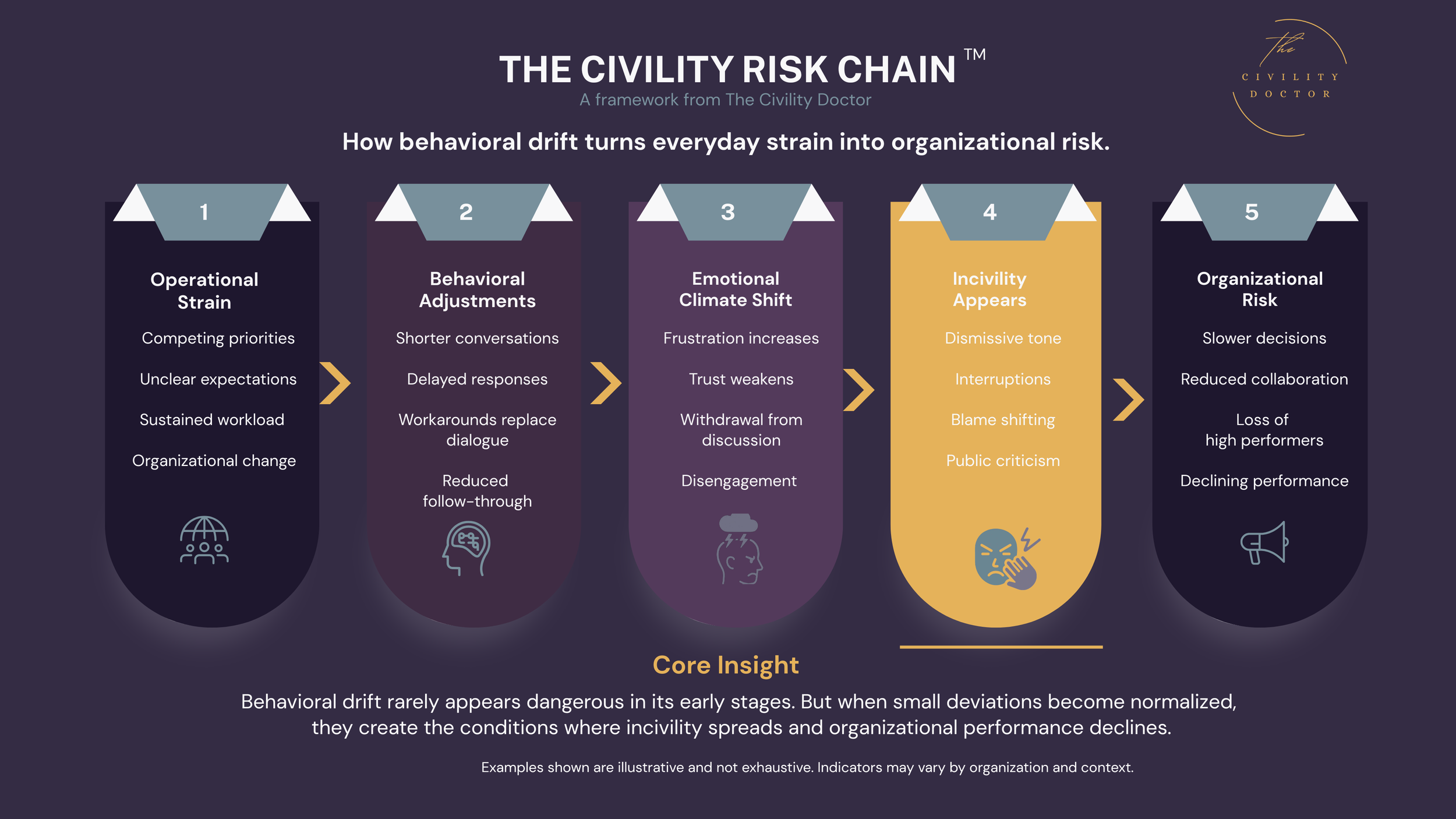
The framework illustrates how organizational strain can gradually move through several stages:
Operational strain introduces pressure into the system through conditions such as competing priorities, unclear expectations, sustained workload, or organizational change.
Behavioral adjustments form under these conditions. Teams make small changes that slowly normalize. Deviations in communication and follow-through become almost routine. Conversations shorten. Responses are slow. Workarounds replace direct dialogue.
Emotional climate shifts over time. Frustration and tension increase. Trust weakens. People withdraw from discussion or disengage from collaboration. These emotions and behaviors spread within teams and often across the organization.
Incivility appears when these conditions persist. Respect is reduced in everyday interactions. Dismissive tone, interruptions, blame-shifting, and public criticism become more common.
Organizational risk ultimately emerges through slower decisions, reduced collaboration, declining performance, and eventual loss of high performers.
By the time incivility becomes visible, the underlying conditions that produced it have often been present for months. Incivility rarely appears as the starting point. It is typically the result of unattended behavioral drift.
Why Leaders Miss the Moment
Most leaders do not ignore culture intentionally. They notice when something feels slightly "off" in their organizations.
The challenge is that early signals rarely look serious. What makes them difficult to interpret is their ambiguity. To a leader:
Shorter conversations appear efficient.
A change in tone or increased tension is attributed to workload and deadlines.
Avoidance is read as restraint or as picking battles.
Delayed responses appear circumstantial.
Optimism also plays a role. Because these behaviors appear small in isolation, leaders assume temporary strain will resolve once conditions stabilize — that the system will self-correct.
Sometimes it does.
But sometimes the behaviors introduced during challenging periods remain long after circumstances improve. When that happens, behavioral drift quietly becomes the new normal. Small deviations compound over time, gradually redefining what becomes acceptable within the organization.
By the time leaders see clear indicators — declining engagement, rising turnover, or escalating conflict — the underlying behavioral patterns have often been developing for months.
What Leaders Can Do Earlier
The sooner leaders intervene, the easier cultural correction becomes. Several practices help stabilize norms before incivility spreads.
1. Reinforce behavioral expectations during strain. Periods of organizational pressure require more clarity around how people interact — not less. Make standards explicit: state what respectful disagreement, responsiveness, and accountability look like in practice. Visible expectations hold; assumed expectations drift.
2. Address small deviations quickly. Shorter conversations, delayed responses, and dismissive tone often signal emerging strain rather than individual personality issues. Treat them as risk signals worth examining — not temporary annoyances to wait out.
3. Model respectful challenge. Show that strong ideas can be challenged without eroding respect. Teams take their cues from leadership behavior; demonstrating how to disagree productively preserves both accountability and trust.
4. Make norms visible. When leaders name behavioral expectations and reinforce them — through both recognition and correction — invisible agreements become shared standards. The behavioral layer and the espoused values begin to align, and culture risk declines.
These actions function as operational safeguards. They protect the behavioral conditions organizations rely on to perform well under pressure.
Culture Risk Rarely Announces Itself
Most leaders look for dramatic signals when assessing culture risk. But the most consequential breakdowns rarely begin with dramatic events. They begin with small shifts in everyday behavior that gradually reshape how people interact, collaborate, and make decisions.
By the time incivility becomes visible, the system has often been drifting for months.
The leadership challenge is not resolving conflict after it appears. It is recognizing the early signals of behavioral drift — and taking action to restore the standards that keep organizations functioning at their best.
That work begins long before incivility shows up. It begins the moment the first small deviation is allowed to look harmless.
Dr. Michelle C.L. Powell is a consulting business psychologist, the founder of The Civility Doctor, and author of the Civility Risk Chain™ framework. She advises senior leaders navigating change events where cultural and behavioral risk are most pronounced.
To explore how this work might apply to your organization, book a discovery call.